


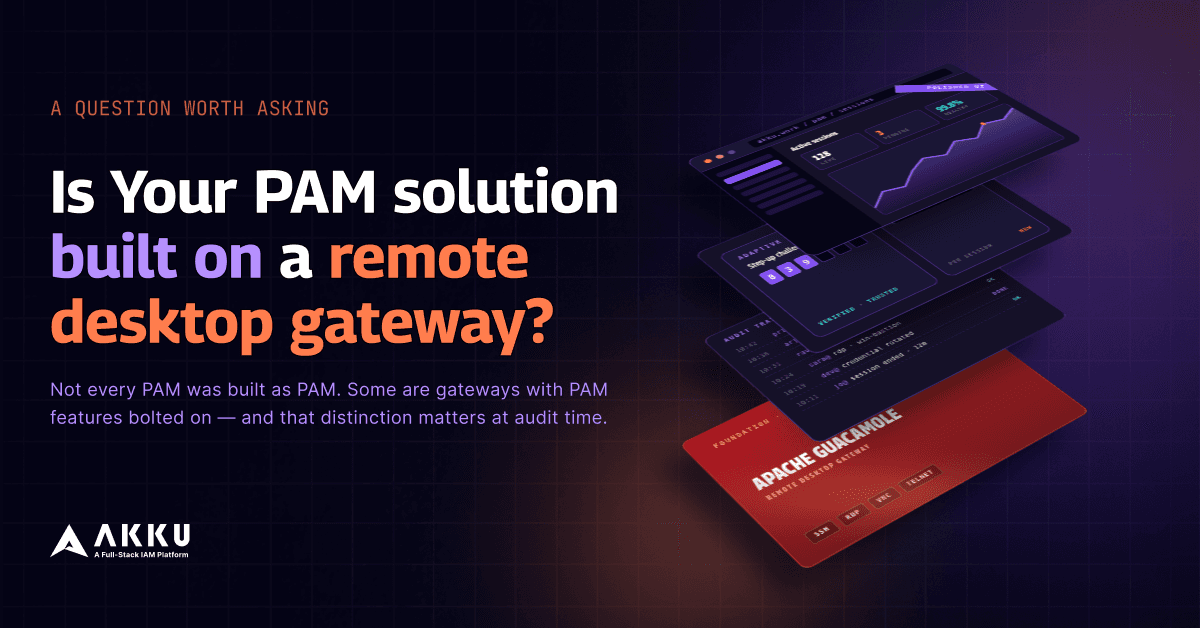
If you are currently evaluating Privileged Access Management solutions, there is a question worth asking the vendors in your shortlist: what is this product actually built on?
Not every PAM solution on the market was built from the ground up as a PAM platform. Some are remote desktop gateways with PAM features bolted on. Some are built on top of open-source tools like Apache Guacamole, a browser-based access gateway that was never designed for privileged access management.
That distinction matters more than most buyers realise. Here is why.
What Apache Guacamole Actually Is
Apache Guacamole is a free, open-source, clientless remote desktop gateway maintained by the Apache Software Foundation. It allows users to access servers via SSH, RDP, VNC, and Telnet through a web browser, with no client software installed.
It is a well-built tool for what it was designed to do: give administrators browser-based access to infrastructure without a VPN. Many IT teams deploy it as a jump server or bastion host. At zero licensing cost, it is an attractive starting point.
But it is a starting point, not a destination for organisations with real security or compliance requirements.
The Problem With Calling It PAM
The term Privileged Access Management describes a specific set of security controls: dynamic credential management, session approval workflows, adaptive multi-factor authentication, compliance-ready audit trails, and least-privilege enforcement. These are the capabilities auditors look for when they assess your PAM posture for SOC 2, ISO 27001, PCI-DSS, RBI, or DPDPA.
Apache Guacamole provides none of these natively.
It records sessions. It logs who connected and when. It can integrate with LDAP for authentication. But credentials are stored statically in its connection configuration, meaning someone in your IT infrastructure knows the actual server password, or it exists in a file that could be accessed. There is no credential vault that generates dynamic, per-session credentials. There is no approval workflow that stands between a user’s request and the target server. There is no adaptive MFA that escalates when a login comes from an unfamiliar device.
This is not a criticism of Guacamole. It was not designed to be a PAM platform. The issue arises when a product built on Guacamole is sold as one.
What a Gateway-Based ‘PAM’ Cannot Do
Credential Security
In a genuine PAM platform, users never see or handle the target credentials. The platform generates a unique, short-lived credential for each session, injects it silently into the proxied connection, and destroys it when the session ends. There is nothing to leak because there is nothing the user ever knows.
In a Guacamole-based solution, credentials are pre-configured and stored statically. The system passes them through, but they exist in a form that can be accessed, extracted, or exposed. Password rotation is manual. A departing administrator who knew a server password still knows it after you delete their account from the gateway.
Session Governance
A PAM platform includes a session approval workflow: a user requests access, an administrator reviews and approves, and only then does the session open. This provides a human checkpoint for every privileged action on critical infrastructure.
Guacamole has no approval workflow. A user with connection access connects immediately. The audit trail tells you what happened, but nothing prevented it from happening.
Database Access
Guacamole does not support database sessions at all. For organisations where database administrators access PostgreSQL, MySQL, or other systems, a Guacamole-based solution provides zero visibility into what SQL queries were executed during a session, a direct gap in any audit that asks for database activity logs.
A purpose-built PAM platform proxies database sessions and captures every query, timestamped and structured, alongside the session recording.
Compliance Evidence
When an auditor asks for evidence of privileged access controls, they are looking for dynamic credential management, session approval records, searchable audit trails, and adaptive MFA. Guacamole can provide a session recording and a connection log. It cannot provide the rest.
For teams pursuing SOC 2, ISO 27001, PCI-DSS, or India’s RBI Cybersecurity Framework and DPDPA requirements, this gap requires additional tooling, tooling that typically costs more than a purpose-built PAM platform would have in the first place.
How to Tell What You Are Actually Buying
When evaluating a PAM solution, ask these questions directly:
- Does the platform generate dynamic, per-session credentials, or does it store static credentials in connection configuration?
- Do users ever see, know, or handle the actual target password, or is credential injection completely invisible to them?
- Is there a session approval workflow where a human must explicitly authorise access before a session opens?
- Does the platform proxy database sessions (MySQL, PostgreSQL) and capture SQL query logs, or only SSH and RDP?
- Is MFA adaptive, does it escalate based on device, location, IP, or time, or is it binary on/off?
- If you remove a user from the identity platform, is their access to all privileged systems revoked immediately, or does the gateway need to be updated separately?
If the answers reveal a gateway with credential pass-through and no approval workflow, you are looking at infrastructure access tooling, not a PAM platform.
What Akku PAM Is Built On
Akku PAM was designed from the ground up as a Privileged Access Management platform, not adapted from a remote desktop gateway. It is built around two purpose-built components.
AkkuArka is the credential vault. It generates a unique credential for each privileged session, server passwords, database users, SSH keys, at the moment access is requested. When the session ends, the credential expires. There are no static passwords in configuration files. There is nothing for a user to know or leak.
AkkuReka is the session proxy. Every privileged connection, SSH, RDP, database, Kubernetes, passes through AkkuReka. Before a session opens, AkkuReka verifies the identity, the device, the location, the IP, the time of day, and the approval status. The session is recorded end to end. Every SSH command, every SQL query, every RDP action is captured, timestamped, and stored in SMART Audit Trails, tamper-proof and fully searchable.
The result is a privileged access architecture where users connect to critical systems without ever knowing the password, every session requires explicit verification, and every action leaves a complete, searchable audit trail.
For organisations with compliance obligations, or for IT teams that simply want to know, with certainty, what is happening on their infrastructure, that is the difference between a remote desktop gateway and a PAM platform.
The Bottom Line
Apache Guacamole is a capable, free, open-source tool. If browser-based server access with basic session recording is all you need, and compliance, credential security, and audit trails are not requirements, it does its job.
But if a PAM solution is being positioned to you as meeting your compliance and security requirements, and it is built on or compared to a remote desktop gateway, the gap between what it promises and what it can actually prove in an audit is worth understanding before you sign.
Ask the six questions above. The answers will tell you what you are actually buying.
See How Akku PAM Works | Talk to the Akku Team
Questions We Hear Most From IT and Security Teams
Q: Is Apache Guacamole a PAM solution?
A: No. Guacamole is a remote desktop gateway. It provides browser-based access to servers but does not include a credential vault, dynamic credential generation, session approval workflows, or adaptive MFA. These define a Privileged Access Management platform.
Q: Can a Guacamole-based solution meet PAM compliance requirements?
A: Partially, and only with significant additional tooling. Guacamole provides session recording and a connection log, which satisfies some audit requirements. But dynamic credential management, session approval workflows, database session logging, and adaptive MFA require either purpose-built additions or a separate platform.
Q: What is the difference between a remote desktop gateway and a PAM platform?
A: A remote desktop gateway provides access to servers via browser or proxy. A PAM platform governs, records, and controls everything about that access: who approved it, what credentials were used, what actions were taken, and whether those credentials still exist after the session ended. The gateway gets you in. The PAM platform is accountable for what happens once you are.
Q: How does Akku PAM handle privileged session access?
A: Every privileged session passes through AkkuReka, which verifies identity, device, location, IP, and approval before opening the connection. AkkuArka generates a unique credential for the session, one the user never sees, and destroys it when the session ends. Every action is recorded and logged in SMART Audit Trails, searchable by user, command, system, or time window.
Q: Does Akku PAM require complex infrastructure like Guacamole?
A: No. Akku PAM deploys a lightweight worker near your target infrastructure. No Tomcat, no guacd, no database to manage. Most organisations are live within hours to a few days without specialist infrastructure expertise.


